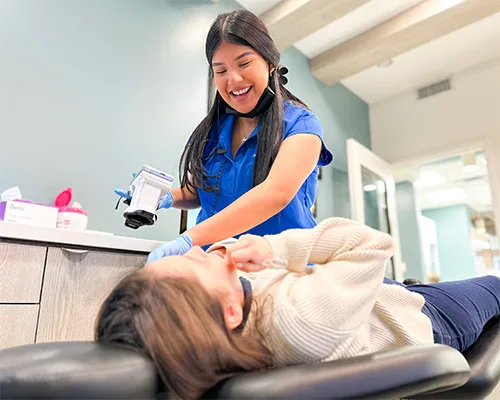

The first orthodontic conversation usually happens at seven. The second, and the one that actually leads to treatment, usually happens between 11 and 14.
That middle-school window is not arbitrary. Most permanent teeth have erupted, the jaw is still growing, and the bite problems that were vague at seven are now clear. It is also the age when a teenager starts to care about how they look, which changes the conversation from "what does my child need" to "what will my child actually tolerate."
Here is what the window means, how the appliance choices differ, and what the next two years look like in practical terms.
Why ages 11 to 14 are the usual window
By 11 or 12, most children have their first and second permanent molars and their permanent canines and premolars. The baby teeth are mostly gone. That gives an orthodontist a complete picture of the bite rather than a preview.
The jaw is also still growing. That growth can be used to correct a crossbite or create room, which is harder after the sutures close. The teen years are the last easy window for skeletal correction before adulthood.
The window is not a deadline. A 15-year-old can still be treated well, and many adults start treatment in their thirties. The advantage of 11 to 14 is efficiency, not eligibility.
If your child already had Phase 1
Children who had early treatment often enter a rest period, where the remaining teeth erupt and the orthodontist watches. Phase 2 begins when most permanent teeth are in.
Not every child who had Phase 1 needs Phase 2. Some finish with a retainer and a stable bite. Others need comprehensive treatment to finish alignment and settle the occlusion. The first visit guide explains how the two phases differ and why early treatment is not a guarantee of a second round.
If your child has not been seen since age seven, book the teen evaluation even if the teeth look straight. Bite problems are often invisible from the front.
Three appliance paths, and how they differ
LightForce 3D-printed braces. Each bracket is printed to fit the contours of the tooth, and the treatment is planned digitally from the scan. The fit is more precise than a stock bracket, which often means fewer irritation visits and more predictable movement. Quest was one of the first practices in Georgia to offer the system.
Traditional metal braces. Stainless steel brackets, proven over decades, and the most affordable fixed option. Modern brackets are smaller than the ones parents remember. They are the workhorse for complex cases and for teens who want colors.
Invisalign for teens. Clear trays with compliance indicators and up to six replacement aligners. They are nearly invisible and removable, which is both the advantage and the risk. A teen who will wear them 20 to 22 hours a day does well. A teen who will not is better served by a fixed appliance.
The right choice depends on the bite, the teen's maturity, and the sports and music schedule. Ask to see all three at the consultation rather than choosing from a website.
What the first year actually looks like
The first visit is a free consultation with an iTero scan and photographs. If treatment is recommended, you get a written plan with a timeline and a fee before you leave.
The bonding appointment is usually the longest visit. Brackets are placed, a wire is tied in, and the teen leaves with instructions. Soreness for two or three days is normal, and soft foods help. The first week is the hardest; after that, most teens forget the braces are there.
Adjustments follow every six to eight weeks. Those visits are short. The wire is changed or tied, elastics are reviewed, and progress is checked. This is also when teens pick new colors, which sounds trivial and is actually one of the reasons some kids tolerate treatment well.
Photos are taken at intervals to track movement. If a bracket breaks, call the office rather than waiting for the next appointment. A loose bracket can stall a tooth for weeks.
Sports, band, and the school day
A teen with braces can play any sport. The requirement is a custom mouthguard, not a generic boil-and-bite one. A custom guard fits over the brackets and protects both the teeth and the appliance.
For sports with a fall season, book the consultation before tryouts. Starting treatment in the middle of a season means the first sore week lands during conditioning, which is avoidable.
Music matters too. Brass and woodwind players often need a few weeks to adapt to the brackets, and a smaller bracket profile helps. Tell us if your child plays, and we can plan the bonding around a concert schedule.
School scheduling is the other practical issue. Both Quest offices open at 7 a.m. Monday through Thursday, so an adjustment can happen before the school run. The Decatur office on Church Street is a few blocks from the MARTA station, which helps families coming from downtown or Oakhurst. Families in the City Schools of Decatur, DeKalb County, and Fulton County systems usually book around the school calendar, and late summer fills first.
Food and hygiene without the lecture
The food list is shorter than most parents expect. Avoid hard candy, nuts, popcorn, gum, sticky caramels, and tough meats. Cut apples into slices and corn off the cob. Everything else is usually fine with care.
Hygiene is the bigger issue. Brackets trap plaque around the gumline, and poor hygiene during treatment can leave white spots on the teeth that are permanent. A soft brush, a floss threader, and a water flosser are the basic kit. A travel brush in the backpack matters more than a lecture at home.
A check at each adjustment catches early gum inflammation. If your teen wears elastics, remind them that the elastics only work when they are in the mouth, not in the pocket.
The compliance variable
Braces compliance is mostly about showing up and avoiding breakages. Aligner compliance is about daily wear, which is a harder ask for a teenager.
Invisalign for teens includes compliance indicators, which show the orthodontist how much the trays were actually worn. That is useful, but it is not a substitute for the habit. The families who succeed with teen aligners tend to have a teen who is self-motivated, not a parent who is doing the reminding.
If the answer to "will you wear this 22 hours a day?" is uncertain, a fixed appliance is the more reliable clinical choice. That is not a judgment about your child. It is a plan that works with their current habits.
What it costs
At Quest, comprehensive treatment with LightForce braces, metal braces, or Invisalign runs $5,450 to $7,750. That includes records, all treatment appointments, removal, and one set of retainers. Phase 1 early treatment, if needed, runs $2,140 to $4,400. The cost guide explains what each fee includes and what it does not.
Dental insurance usually covers a portion of teen orthodontics, often up to a lifetime maximum of $1,000 to $2,500, with age limits that commonly end at 19 or 21. The office submits a predetermination before treatment so you know the out-of-pocket number rather than the brochure number. FSA and HSA funds can also be used.
In-house, interest-free financing is available, and CareCredit is accepted. Ask for the terms in writing.
Retainers and the years after
Every completed case includes a set of retainers. The Lifetime Smile Guarantee adds replacement retainers at a predictable cost, check-ins at either office or remotely, and access to the team after treatment.
Teens are the group most likely to lose a retainer at college or stop wearing it when it feels tight. Plan for that now. A retainer that is replaced in the first month is a cheap fix. A retainer that is ignored for five years is often a new treatment.
Questions to ask at the consultation
Who does the adjustments? At some practices, the owner plans and assistants adjust. At Quest, Dr. Patel is the orthodontist behind the plan and sees patients at both offices.
What happens if treatment runs long? Ask about extension fees before you sign.
How do you handle a broken bracket on a Friday? There should be a same-day or next-day plan, not a voicemall.
Do you recommend extractions for my child? If the answer is yes, ask why and what the alternative would be. MARPE or arch development can sometimes avoid extractions, and it is fair to ask.
What is the total, including retainers and any refinement? The monthly number is not the total. Ask for the full figure.
Local access
The Sandy Springs office at 6065 Roswell Road is just north of I-285, convenient for Buckhead, Dunwoody, Vinings, and East Cobb. The Decatur office at 720 Church Street is a few blocks from Decatur Square and the MARTA station.
You can book a free consultation online or call (470) 440-7330. Bring your insurance card and any images from a previous orthodontist. A second opinion is welcome, and comparing two written plans is easier than comparing two memories of a conversation.
If your teen is 15 or older
The window is not closed at 14. Older teens are treated every day, and the results are just as good in most cases. What changes is the mechanics.
Growth is mostly finished by 15 or 16, especially in girls. That means the jaw cannot be guided as much, and a skeletal crossbite that would have been simple at 12 may need MARPE or surgery at 17. Dental crowding is still straightforward.
The social calendar changes too. A 16-year-old may prefer aligners for prom and photos, or may want braces finished before college. Starting at 16 usually means finishing at 18, which is a fine timeline if the case is planned around it. Starting at 17 and leaving for college mid-treatment is harder, because adjustments and emergency care need to continue somewhere.
If your teen is close to leaving home, ask what the transfer plan is. Remote monitoring can cover part of it, but not all. A practice that has a plan for college moves is easier to finish with than one that does not.
Frequently asked questions
What is the best age for braces?
Most teens start between 11 and 14, once most permanent teeth have erupted and while the jaw is still growing. The right age for your child depends on the bite, not the birthday.
How long do teens wear braces?
The average is 18 to 24 months. Complex cases run longer, and simple cases can finish sooner. Missed appointments and broken brackets extend the timeline.
Can my teen play sports with braces?
Yes. A custom mouthguard protects the braces and the teeth. Book the bonding around the season, and bring the guard to every game and practice.
Are clear aligners better for teenagers?
They are better for teens who will wear them 20 to 22 hours a day and who care about discretion. Braces are more reliable for teens who need a fixed appliance. Invisalign for teens includes compliance indicators and replacement aligners, but it still depends on daily wear.
How much do teen braces cost in Sandy Springs?
Comprehensive treatment at Quest runs $5,450 to $7,750, including records, appointments, and retainers. Phase 1, if needed, runs $2,140 to $4,400. Insurance may cover part of the fee.
Will braces leave white spots on the teeth?
Only if hygiene is poor during treatment. Brackets trap plaque, and demineralization leaves permanent white marks. A soft brush, floss threader, and water flosser prevent most of it.
Do teens need retainers forever?
Most orthodontists recommend long-term nightly wear, with more frequent wear in the first months. Retainers can be replaced at a predictable cost under the Lifetime Smile Guarantee.
About the author: Dr. Arjun Patel, DMD is a board-certified orthodontist and the owner of Quest Orthodontics in Sandy Springs and Decatur, Georgia. He is a Top 1% Invisalign Blue Diamond provider, an Atlanta Magazine Top Dentist from 2019 through 2026, and a graduate of the University of Georgia and the Medical College of Georgia.