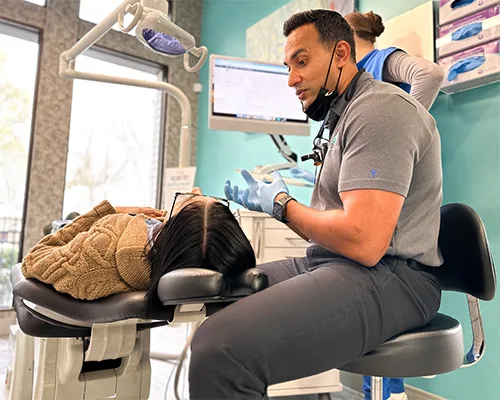

Many of the adults we treat in Sandy Springs and Decatur had braces as teenagers. They wore their retainer for a while, then life happened, and now the front teeth are crowding again. Others never had braces and have spent 20 years thinking about it. A few are getting married, changing jobs, or turning 40 and deciding this is the year.
What they have in common is a practical question: can I actually do this without it taking over my life?
The honest answer is yes, for most people, but not in the way the marketing suggests. Invisalign is not invisible, it is not effortless, and it is not a shortcut. It is a real orthodontic appliance that requires discipline and a few adjustments to your routine. Here is what the next 12 to 18 months actually look like.
Why teeth shift after teenage braces
Teeth do not stop moving when treatment ends. They settle, wear, and drift throughout adulthood, and the lower front teeth are usually the first to show it.
Three things drive the change. The first is retainer lapse. Most people stop wearing retainers in their twenties, and the teeth gradually return toward their original positions. The second is normal aging. Jawbone changes and years of chewing alter the shape of the dental arch. The third is function. Grinding, clenching, gum disease, and untreated bite problems can move teeth over time.
This is why adult orthodontics is rarely just cosmetic. Crowding can make teeth harder to clean, which raises the risk of decay and gum disease. A shifting bite can cause uneven wear, jaw pain, and broken restorations. Straightening the teeth can be the most conservative way to protect everything else.
What adult treatment is really for
Patients usually come in wanting a better smile. That is a legitimate goal. A smile affects how you show up in photographs, on video calls, and in meetings, and many adults say the confidence change was worth the cost on its own.
But there are clinical reasons too. Aligned teeth are easier to brush and floss. A balanced bite distributes force evenly instead of concentrating it on a few teeth. Correcting a deep bite can protect the front teeth from wear. Closing spaces can improve speech and eating. For patients with jaw pain, alignment is sometimes part of a broader TMJ treatment plan, though not every jaw problem is solved by moving teeth.
If you are considering treatment, ask what it will change functionally, not just aesthetically. A good orthodontist will answer both.
Is Invisalign the right tool for your case?
Invisalign works well for many common adult problems: crowding, spacing, mild to moderate overbites, and cases where teeth need to be tipped or rotated into better positions. Modern aligners can handle more complex movement than the early systems could, especially with attachments and refinements.
It is not the right tool for every case. Severe skeletal discrepancies, impacted teeth, significant transverse deficiency, and cases that require major jaw movement may need braces, MARPE expansion, or orthognathic surgery. Some complex tooth movements are still more predictable with fixed brackets.
This is why the consultation matters more than the brand. A practice that recommends Invisalign for everything is not diagnosing. A practice that tells you braces would produce a better result, even though you came in asking for aligners, is worth listening to.
At Quest, we offer both Invisalign and LightForce custom braces, so the recommendation can follow the case rather than the other way around. For adults with a narrow upper jaw, MARPE can sometimes create room that aligners alone cannot.
The 22-hour math
Invisalign aligners need to be worn 20 to 22 hours a day to move teeth on schedule. That leaves roughly two hours for eating, drinking anything other than water, and brushing.
Two hours sounds generous until you map it onto a real day. Coffee at your desk takes 20 minutes. Lunch with a client takes an hour. A glass of wine at dinner takes 30. Suddenly you are at the limit, and the aligner has been out for three hours.
The patients who finish on time tend to follow a few habits:
- Keep the case with you, always. Aligners get lost when they are wrapped in a napkin. A case in your bag or desk drawer solves most of that.
- Drink water with the aligners in. Anything else, including coffee and sparkling water, should come out. Hot drinks can warp the plastic, and sugary drinks trap liquid against the teeth.
- Brush before reinserting. Trapped food and sugar under an aligner is a cavity waiting to happen. A travel brush and floss in your bag is not optional.
- Plan around the important meals. If you have a long dinner, take the aligner out, enjoy it, and add an extra hour of wear the next day. One meal will not ruin a case. A pattern will.
- Set a timer on your phone. The first two weeks are the hardest. After that, the routine becomes automatic.
A note on meetings and presentations: the first week with a new aligner can produce a slight lisp. It usually resolves within a few days. If you have a major presentation, ask to change aligners on a Friday rather than the morning of the meeting.
What nobody tells you before you start
You will have attachments. Most Invisalign cases use small tooth-colored bumps bonded to certain teeth to help the aligner grip and move them. They are not invisible up close, though they blend in at conversation distance. They come off at the end.
You may need interproximal reduction. Some cases require tiny amounts of enamel to be polished away between teeth to create room. It sounds worse than it is, and it is permanent but minimal.
Refinements are normal. Many cases finish the first set of aligners and then need a second set to close small gaps or fine-tune the bite. Ask how refinements are priced before you start, and get the answer in writing.
Aligners need cleaning. They pick up odor and stains if you only rinse them. Clean them daily with a soft brush and clear soap or aligner cleaner, and skip the hot water.
The retainer is the real finish line. Teeth will shift back if you stop wearing a retainer. Plan for nightly wear indefinitely, and ask what replacements cost. Our Lifetime Smile Guarantee is built around this gap: predictable retainer replacements and ongoing support after treatment ends.
Fewer visits, same oversight
Traditional braces require adjustments every four to eight weeks. Invisalign often needs visits every 8 to 12 weeks, and remote monitoring can reduce that further.
Quest uses Grin remote monitoring. Patients receive a small scope that attaches to a smartphone and captures intraoral photos at home. Those images go to Dr. Patel's secure dashboard, and he can confirm that teeth are tracking, recommend holding an aligner a few extra days, or bring you in if something needs attention.
For adults who travel, work long hours, or manage a family schedule, that is a meaningful change. It does not eliminate in-person care, but it cuts the number of appointments where you sit in traffic for a five-minute check.
A realistic month-by-month timeline
Month 1: Consultation, scan, and treatment plan. If you proceed, you receive your first aligners and any attachments are placed. The first week is the most uncomfortable, mostly pressure and a slight lisp.
Months 2 to 6: You change aligners every one to two weeks, depending on the plan. Most patients notice visible movement in the front teeth by month three or four.
Months 6 to 12: The bite starts to settle. You may need new attachments or a mid-course correction if a tooth is not tracking.
Months 12 to 18: Many cases finish in this window. Refinement aligners may follow for a few weeks or months.
The end: Final records, retainers, and a follow-up schedule. Nightly retainer wear begins.
Every case is different. Complex crowding, bite correction, and cases that combine expansion with aligners take longer. A good plan gives you a range, not a guarantee.
What it costs, and how adults pay for it
At Quest, comprehensive Invisalign for adults ranges from $5,450 to $7,750, including records, all appointments, and one set of retainers. That is the same range as comprehensive braces, because the planning and visit schedule are the same. MARPE and surgical cases are quoted separately.
Dental insurance is the catch. Many plans exclude adult orthodontics entirely or cap coverage at a low lifetime maximum, and age limits often end at 19 or 21. Read your plan before you assume you are covered.
The good news is that orthodontic treatment is an eligible expense for HSAs and FSAs. If you have an FSA, remember that the funds usually must be used within the plan year, so timing your start date matters. Quest offers interest-free in-house financing and CareCredit, so the fee can be spread across treatment rather than paid up front. Our cost guide explains what a fair fee includes and the questions to ask before you sign.
Adult-specific health considerations
Adults are not just older teenagers. Treatment planning has to account for things that do not exist in a 13-year-old's mouth.
Gum health. Receding gums and periodontal disease can affect how teeth move and how well they hold their position. We screen for this and coordinate with your dentist or periodontist when needed.
Existing restorations. Crowns, bridges, and implants do not move the way natural teeth do. Aligners can be designed around them, but the plan has to account for them from the start.
Root resorption. Long-term force can shorten tooth roots in susceptible patients. We monitor with X-rays, especially in longer cases.
Bite and jaw joints. Adults with a deep bite, crossbite, or jaw pain may need a plan that addresses the joint as well as the teeth.
Sleep and breathing. Adults who snore or wake up unrefreshed may have sleep apnea. Orthodontics can address structural contributors such as a narrow palate, but it does not replace a sleep study or medical evaluation. Our sleep apnea page explains how we screen and coordinate care.
Align first, then whiten, bond, or veneer
If you are also considering cosmetic dentistry, sequence matters. Moving teeth into the right position first often reduces how much enamel needs to be removed for veneers, or eliminates the need for them entirely.
Whitening after treatment is straightforward. Bonding and veneers are usually placed after the bite is stable, because the final tooth position determines the shape and thickness of the restoration. Starting with veneers and then moving teeth can ruin both.
Ask your orthodontist and dentist to talk to each other before either plan begins. At Quest, we are happy to coordinate with your general dentist.
Getting to appointments in Atlanta
The practical question for most working adults is not whether treatment works. It is whether they can get to the office without burning a vacation day.
The Sandy Springs office at 6065 Roswell Road sits just north of I-285, which is convenient if you work in Buckhead, Dunwoody, Vinings, or East Cobb. The Decatur office at 720 Church Street is a few blocks from Decatur Square and the Decatur MARTA station, which helps if you work downtown, at Emory, or at the CDC.
Both offices open at 7 a.m. Monday through Thursday. A 7 a.m. adjustment can be done before your first meeting, and remote monitoring means some of those visits disappear entirely. You can book a consultation online or call (470) 440-7330.
Frequently asked questions
Can I drink coffee with Invisalign?
Take the aligners out first. Hot coffee can warp the plastic, and coffee with milk or sugar will stain the aligner and sit against your teeth. Drink it before you put the aligner back in, and rinse with water afterward.
Will people notice I am wearing Invisalign?
Most people will not notice at conversation distance. Up close, they may see the attachments and a slight sheen. The first week with a new aligner can cause a mild lisp, which usually fades within a few days.
How long does adult Invisalign take?
Most cases run 12 to 18 months, with refinements adding a few weeks or months. Complex crowding or bite correction can take longer. Your scan and treatment plan will give you a specific estimate.
Is Invisalign cheaper than braces for adults?
For many comprehensive cases, the two are priced similarly. Limited aligner cases can cost less. The fee depends more on complexity and treatment length than on the appliance itself.
Can I get Invisalign if I have crowns or implants?
Often yes. Crowns and implants do not move, but aligners can be designed around them, and other teeth can be moved into position. The plan has to account for the restorations from the beginning, which is one reason a scan and exam matter.
What happens if I lose an aligner?
Call the office. If you are early in a set, you may be able to move to the next aligner or wear the previous one until a replacement arrives. Do not jump ahead without guidance, because the timing affects how teeth track.
Do I need a retainer forever?
Most orthodontists recommend nightly retainer wear indefinitely, with occasional checks. Teeth continue to shift with age, and the retainer is what protects the investment. Replacement costs are modest compared with retreatment.
Start with a scan, not a commitment
A consultation is the cheapest part of this process and the most useful. You will see your teeth on a screen, learn whether aligners can fix your specific problem, and get a written plan with a real number. If Invisalign is not the right choice, we will tell you what is.
Call Quest Orthodontics at (470) 440-7330 or book a complimentary consultation at our Sandy Springs or Decatur office.
About the author: Dr. Arjun Patel, DMD is a board-certified orthodontist and the owner of Quest Orthodontics in Sandy Springs and Decatur, Georgia. He is a Top 1% Invisalign Blue Diamond provider, an Atlanta Magazine Top Dentist from 2019 through 2026, and a graduate of the University of Georgia and the Medical College of Georgia.