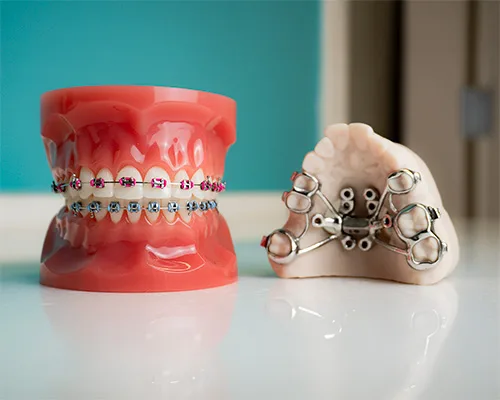

For decades, the script for an adult with a norrow upper jaw was short. Wear braces, accept the crossbite, or schedule jaw surgery. There was not much in between.
That script has changed. MARPE, miniscrew-assisted rapid palatal expansion, gives orthodontists a way to widen the upper jaw in late adolescents and adults without cutting bone. It is not a miracle and it does not fit every case. But for the right patient, it can replace a surgery that comes with general anesthesia, swelling, and a long recovery.
Here is what MARPE actually is, who it helps, what the published evidence says, and what the process looks like at Quest.
What MARPE actually is
The upper jaw, the maxilla, is two halves joined at the midpalatal suture, the seam that runs down the roof of the mouth. In children, that seam is flexible. An expander can push the halves apart and new bone fills the gap.
By the late teens and twenties, the suture interlocks and stiffens. A tooth-borne expander then tips teeth outward instead of moving bone, which is why conventional expansion stops working in adults. The surgical answer, SARPE, cuts the suture free before expanding. It works, but it is a hospital procedure.
MARPE takes a different route. Small titanium miniscrews are placed into the bone of the palate, and a rigid expander is anchored to those screws rather than to the teeth. The force goes directly into the bone and the suture, not into the teeth. Over weeks of controlled activation, the suture opens and the maxilla widens.
The name covers a family of protocols. MARPE usually refers to rapid expansion, while MASPE refers to a slower, mini-implant-assisted version. Both use the same principle: bone-borne anchorage instead of tooth-borne or surgical anchorage.
Who is a candidate
MARPE is considered when the upper jaw is genuinely norrow, not just when the teeth are crowded.
The classic candidates are adults and older teens with a posterior crossbite, where the upper back teeth bite inside the lower back teeth. Others have severe crowding with no room to align teeth without extractions. Some have a high, norrow palate that contributes to mouth breathing or snoring. And a large group has already been told by another provider that jaw surgery is the only path.
The diagnosis is not made by looking in the mouth. It is made with a 3D CBCT scan that shows the suture, the bone thickness, the roots, and the nasal floor. That scan is what separates a patient who can be expanded from one who cannot.
MARPE is not the right choice for every norrow jaw. Severe skeletal discrepancies, significant asymmetry, and cases where the suture is completely ossified may still need SARPE or orthognathic surgery. A practice that offers MARPE to everyone with crowding is not diagnosing.
What the evidence says
MARPE has a growing but not enormous evidence base, and the numbers are worth knowing before you commit.
A prospective study of 32 adults aged 18 to 49 reported successful non-surgical expansion in 84.4% of patients. The average expansion was about 5.4 mm at the front of the palate and 2.5 mm at the back. Complications occurred in 18.5% of the successful cases, mostly hardware-related: minor deformation or loosening of the miniscrews. Age mattered. Success was higher and complications lower in younger adults, and the odds of needing surgery rose with each year beyond 18.
Other reviews report mean success rates closer to 90%, with a range that runs from roughly 70% to 95% depending on the protocol and the definition of success. The honest summary is that MARPE works in most adults, works better in younger ones, and carries a real failure rate that should be discussed before treatment starts.
That failure rate is not a reason to avoid MARPE. It is a reason to choose a provider who plans for it, monitors the screws, and has a clear path to SARPE if expansion stalls.
MARPE versus SARPE versus childhood expansion
Childhood expansion uses a tooth-borne or bone-borne expander while the suture is still flexible. It is faster, simpler, and usually done between ages 7 and 14. This is the conventional palatal expander most parents recognize.
SARPE is surgically assisted rapid palatal expansion. The surgeon makes cuts in the maxilla, then the expander is activated. It is reliable and can produce large movements, but it requires general anesthesia, has more postoperative discomfort, and carries surgical risks.
MARPE sits in between. It avoids osteotomy and general anesthesia in most cases, uses miniscrews for anchorage, and can produce several millimeters of skeletal expansion. It is less invasive than SARPE but more technique-sensitive, and it does not work in every anatomy.
For a parent reading this because a child has a norrow palate, the answer is usually a conventional expander, not MARPE. MARPE is for the patients whose growth window has closed.
The process at Quest
The first step is a free consultation and a 3D CBCT scan. Dr. Patel reviews the suture, bone thickness, roots, and airway, then explains whether MARPE is realistic, what expansion is likely, and what the alternatives are.
If you proceed, a custom expander is fabricated for your anatomy. The miniscrews are placed in the palate under local anesthesia, and the device is attached. There is a healing period before activation begins so the screws integrate with bone. Then you activate the device on a schedule, usually turning a small screw a set amount, with regular visits to monitor movement and tissue health.
When the planned expansion is reached, the device stays in place for a retention period while new bone matures. That phase is not optional. Removing the appliance too early is one of the ways expansion relapses.
Once the expansion is stable, the orthodontic phase begins. Most patients still need braces or Invisalign to align the teeth and settle the bite. MARPE creates the space; it does not finish the smile on its own.
What it feels like
The placement itself is usually easier than patients expect. The palate is numbed, the screws go in without a surgical incision in most protocols, and most people return to work or school the next day.
The activation period is the part that takes adjustment. Patients describe pressure across the nose and upper jaw, a temporary lisp, and difficulty with hard foods for the first few days after each activation. Some feel a popping or releasing sensation when the suture opens, which is normal. Pain is usually manageable with over-the-counter medication, and most patients miss no more than a day of normal activity.
Hygiene matters more than usual. Food can collect around the appliance, and the tissue around the miniscrews can become inflamed. A water flosser and a soft brush are not optional during this phase.
The breathing question
Widening the upper jaw raises the floor of the nasal cavity and can reduce resistance in the nasal airway. Patients with a norrow palate often report easier nasal breathing after expansion, and some snore less.
That is a real benefit, but it is not a cure for sleep apnea. Apnea involves the soft tissues of the throat, the tongue, and the nervous system's control of breathing. An orthodontist can identify structural contributors and coordinate with an ENT or sleep physician, but a sleep study is what diagnoses apnea. Our sleep and airway page explains how we screen and refer.
Be skeptical of anyone who promises that expansion will cure snoring. It may help a structural component. It cannot rule out a airway disorder on its own.
How long it takes
There is no single timeline, because expansion depends on age, suture stiffness, and how much widening is needed.
In published protocols, active expansion often runs from several weeks to a few months. The retention period that follows is usually measured in months, not weeks. Then the alignment phase with braces or Invisalign adds its own 12 to 24 months depending on the case.
Patients should plan on a process measured in years, not months, if they are counting from the first scan to the final retainer. The advantage is that the alternative, jaw surgery, also takes months to recover from and does not include the alignment.
What it costs
MARPE is quoted separately from comprehensive braces or Invisalign because it involves a custom appliance, miniscrews, additional imaging, and a separate phase of care. It is not included in Quest's $5,450 to $7,750 comprehensive range.
Dental insurance rarely covers MARPE. Some plans may apply out-of-network benefits or cover the orthodontic phase, but the expansion itself is usually treated as an exclusion. HSA and FSA dollars can often be used because the treatment is medical, and patients should confirm the rules with their plan administrator.
The consultation will include a written quote with the appliance, the scans, the placement, the activation visits, and the retention phase separated so you can see what you are paying for.
Questions to ask before you commit
What is my suture stage on the CBCT? The scan should show whether the suture is open enough for a non-surgical approach.
What is your success rate in patients my age? Published rates are useful, but the practice's own experience matters more.
What happens if expansion stalls? There should be a plan for converting to SARPE or stopping, and a clear explanation of the additional cost.
Who manages the miniscrews if one loosens? This is the most common complication, and it should be handled in-house or with a named oral surgeon.
How long is retention, and what happens if I stop wearing the appliance? Retention protects the result. It is not a formality.
Will this change my face? Expansion moves the maxilla forward and widens the midface slightly. The change is usually subtle, but it is real, and you should see a simulation or a clear explanation before you start.
Local access
Quest performs MARPE planning at both offices, with the 3D CBCT at the Decatur office on Church Street. That location is a few blocks from Decatur Square and the MARTA station, which makes the imaging and follow-up visits practical for patients coming from downtown, Oakhurst, or Druid Hills. Patients from Sandy Springs, Buckhead, and Dunwoody often use the Roswell Road office for the orthodontic phase.
You can book a consultation or call (470) 440-7330. If you have already been told you need jaw surgery, bring the imaging and the recommendation. A second opinion is often the reason patients find this option in the first place.
Frequently asked questions
Is MARPE painful?
Most patients describe pressure rather than sharp pain. Placement is done with local anesthesia. Activation causes a few days of soreness and a temporary lisp after each turn, usually managed with over-the-counter medication.
How long does MARPE take?
Active expansion often takes several weeks to a few months, followed by months of retention. If braces or Invisalign are needed afterward, add 12 to 24 months. The full process is usually measured in years.
Does insurance cover MARPE?
Rarely. Most dental plans exclude the expansion appliance or treat it as out-of-network. The orthodontic phase may have some coverage. HSA and FSA funds can often be used, but confirm the rules with your plan.
What is the difference between MARPE and SARPE?
SARPE is surgically assisted expansion. It requires cutting bone and usually general anesthesia. MARPE uses miniscrews anchored in the palate to expand without osteotomy. MARPE is less invasive but not appropriate for every anatomy.
Is there an age limit for MARPE?
There is no hard cutoff, but success falls with age. Published success is highest in late teens and young adults, and the odds of complications rise with each year beyond 18. A CBCT is the only way to know how your suture will respond.
Does MARPE change the shape of your face?
It widens the upper jaw and can slightly change the midface and nasal base. The change is usually subtle and planned, not dramatic. Ask to see the predicted movement before you consent.
Can MARPE cure sleep apnea?
No. It can widen the nasal airway and reduce resistance, which may improve breathing and snoring. Apnea requires a sleep study and medical management. MARPE can be part of a team approach, not a replacement for one.
About the author: Dr. Arjun Patel, DMD is a board-certified orthodontist and the owner of Quest Orthodontics in Sandy Springs and Decatur, Georgia. He is a Top 1% Invisalign Blue Diamond provider, an Atlanta Magazine Top Dentist from 2019 through 2026, and a graduate of the University of Georgia and the Medical College of Georgia.